The creative brief has long been the backbone of advertising, guiding teams from initial concept to final campaign execution. But in 2025, a fundamental transformation is reshaping how marketers communicate their vision—prompt engineering has emerged as the modern creative brief for the AI age. Just as a well-crafted brief once aligned designers, copywriters, and strategists, a well-structured prompt now directs AI systems to produce brand-safe, channel-aware content that resonates with audiences.
This isn’t merely a technological shift; it’s a philosophical evolution in how creative direction works. Marketers who understand this parallel are quietly achieving 90% accuracy improvements and saving 3+ hours per piece of content, while 43% of marketers still struggle to extract maximum value from AI tools. The difference isn’t the AI platform—it’s the quality of communication feeding it.
The Remarkable Parallel: Creative Briefs Meet AI Prompts
The structure of an effective prompt mirrors the anatomy of a traditional creative brief with striking precision. Both serve the same fundamental purpose: translating business objectives into actionable creative direction. As one expert notes, “Think of AI as a keen intern: fast, eager, but inexperienced. A good prompt acts as their creative brief”.
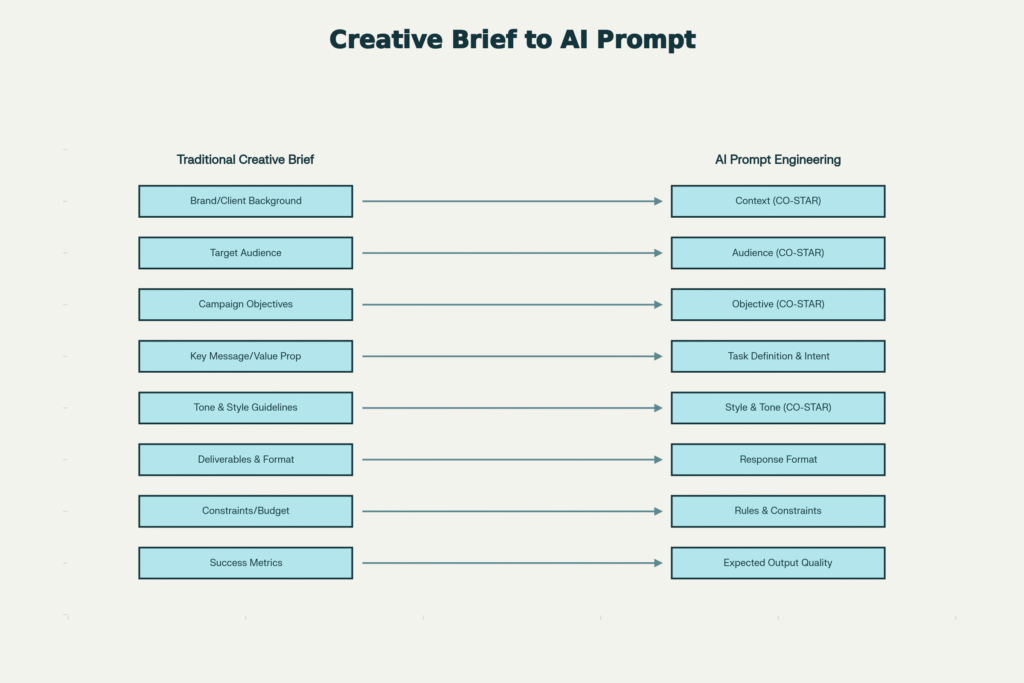
Creative Brief vs AI Prompt: A Side-by-Side Element Mapping
When marketers clearly define the audience, objective, constraints, and success metrics inside a prompt, they give AI the context it needs to move past generic recommendations into brand-safe, channel-aware guidance that can be trusted in real planning, activation, and measurement workflows. This is precisely what creative briefs have accomplished for human teams for decades.
The parallel extends to consequences as well. Just as a vague brief produces unfocused campaigns, a generic prompt yields generic outputs. The computing adage “garbage in, garbage out” has never been more relevant than in the era of generative AI. A prompt like “write something about marketing” returns textbook-style content, while a specific prompt—”Write a short LinkedIn post, friendly tone, about how small businesses can use AI to save time on marketing”—delivers clear, engaging, shareable material.
The CO-STAR Framework: Anatomy of a Modern Creative Brief
The most successful marketers are adopting structured prompt frameworks that mirror traditional briefing methodologies. The CO-STAR framework, developed by GovTech Singapore’s Data Science & AI team and winner of Singapore’s first GPT-4 Prompt Engineering competition, has become a gold standard for crafting effective AI prompts.
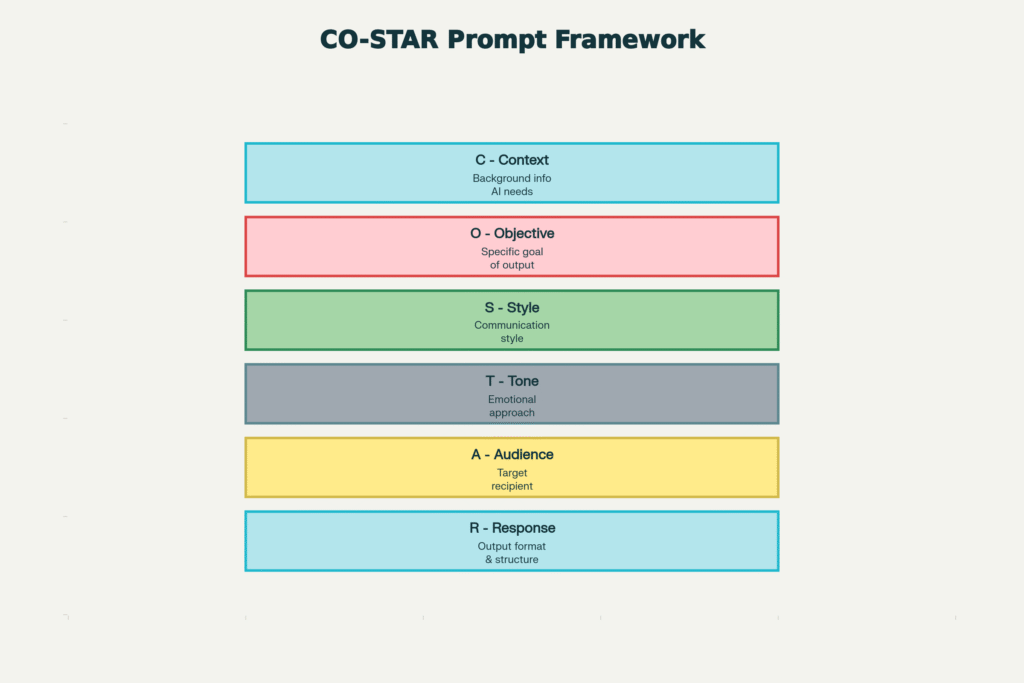
The CO-STAR Framework: Anatomy of an Effective AI Prompt
Each CO-STAR element maps directly to traditional brief components:
This structured approach transforms prompting from random experimentation into repeatable, auditable creative direction. Leading marketers are now documenting proven prompts, embedding them into tools, and training media, analytics, and creative teams to use consistent structures.
The Explosive Market Validation
The business world has recognized prompt engineering’s strategic importance. The global prompt engineering market is experiencing exponential growth, expanding at a compound annual growth rate of approximately 32-33%.
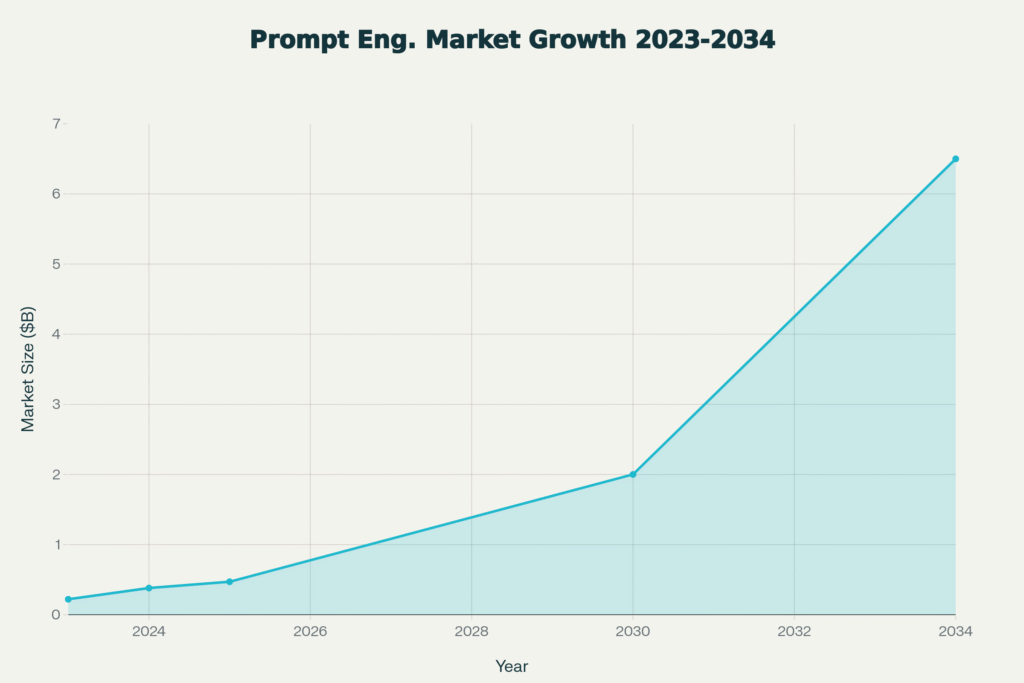
Prompt Engineering Market Growth: From $0.22B (2023) to $6.5B (2034) at 33% CAGR
This growth reflects something deeper than technological adoption—it signals a fundamental shift in how businesses communicate with AI systems. Organizations across finance, healthcare, e-commerce, and digital media are incorporating generative AI solutions, necessitating precisely tailored prompts to enhance AI effectiveness. The investment community has noticed: prompt engineering now ranks among the Top 10 fastest-growing tech roles globally.
For marketers specifically, this represents an unprecedented opportunity. Prompt engineering expertise commands 27% higher wages, and LinkedIn reports a 434% increase in job postings mentioning prompt engineering since 2023. Average salaries for prompt engineers hover around $123,000-136,000 annually, with top-tier positions at AI-focused companies reaching the mid-$200,000s.
AI Adoption: The New Marketing Reality
The transformation isn’t theoretical—it’s happening at scale across the marketing industry.
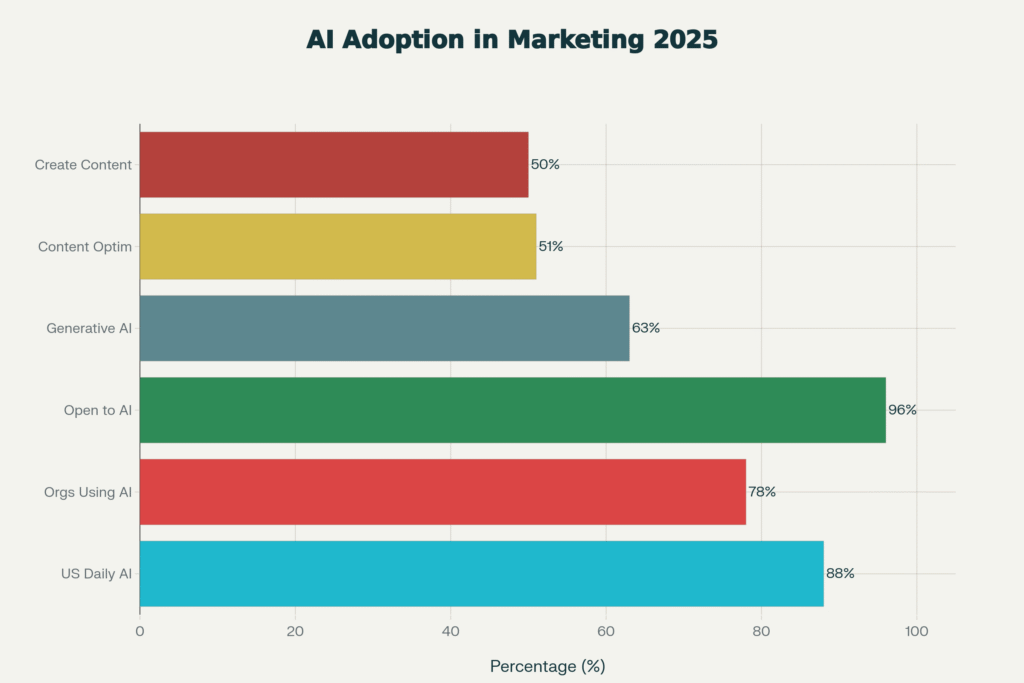
AI Adoption Among Marketers: 2025 Statistics
These statistics reveal a clear pattern: marketers have embraced AI as a core workflow component, not merely an experimental tool. The market for AI in marketing has reached $47.32 billion in 2025, up from $12.05 billion just five years earlier, with projections exceeding $107 billion by 2028. Organizations using AI in at least one business function jumped from 55% to 78% in just one year.
Critically, marketing and sales departments lead enterprise AI adoption, with 42% of marketing and sales teams “regularly using” generative AI—rising to 55% in tech companies. This widespread adoption makes prompt engineering skills increasingly essential for marketing career advancement.
The ROI Reality: Why This Skill Matters
The business case for prompt engineering proficiency extends beyond efficiency—it directly impacts the bottom line.
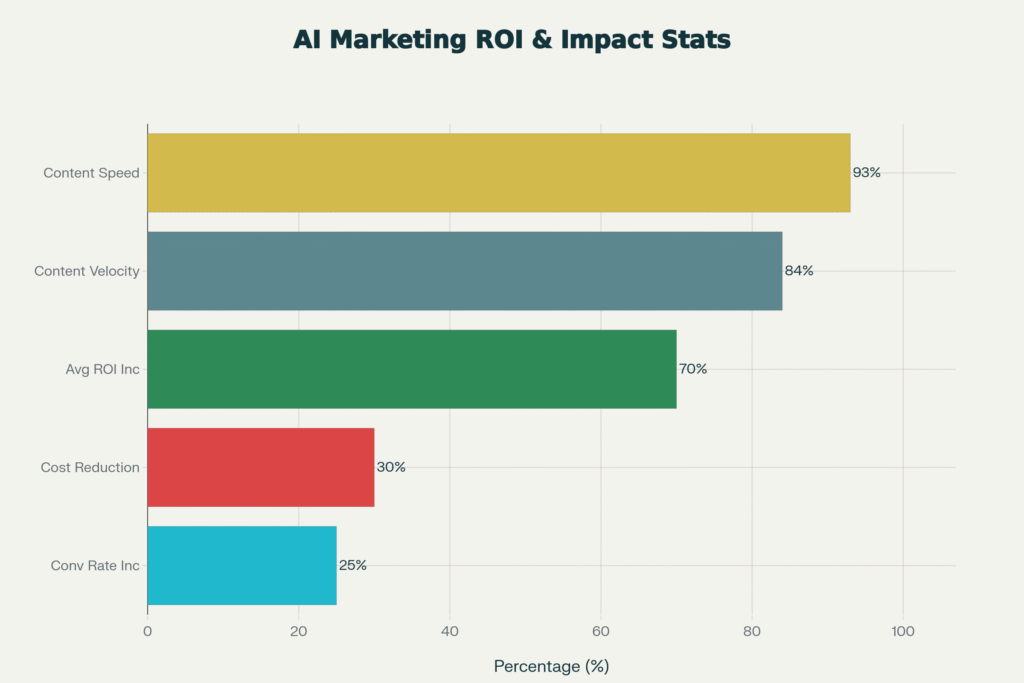
The ROI of AI in Marketing: Key Performance Improvements
According to industry research, marketers who effectively leverage AI see an average 70% increase in ROI. A Deloitte analysis found AI investments generate 3.5× higher average ROI than other tracked technology categories. McKinsey reports that marketing and sales leaders attribute a median 15% of their EBIT directly to AI adoption.
The impact manifests across multiple dimensions:
Content Velocity: AI-powered teams deliver content 84% faster than traditional workflows, compressing time-to-market for campaigns. One global CPG brand achieved 3× faster content turnaround and a 25% reduction in cost per asset through optimized AI workflows.
Conversion Performance: A mid-market fintech platform using AI-first content pipelines achieved 22% YoY growth in organic sessions and a 19% lift in overall marketing ROI. A digital learning marketplace documented a 27% uplift in lead-to-enrollment conversion and 31% ROMI improvement.
Campaign Results: Heinz’s AI-driven image campaign generated over 850 million earned impressions with social engagement 38% higher than previous campaigns. Virgin Holidays achieved a 2% increase in email open rates through AI-powered copywriting, translating to millions in additional revenue.
From Brief to Prompt: A Skills Translation Guide
The good news for marketing professionals: the skills developed crafting creative briefs translate directly to prompt engineering excellence. “After taking a prompt engineering certification, the biggest reveal was how much I already knew: two decades of writing briefs, digesting stakeholder documents, and shaping ideas into actionable direction translated directly to AI”.
Best Practices for Marketing Prompt Engineering
Be Specific and Clear: Include tone, length, format, keywords, and audience in every prompt. Generic prompts yield generic results.
Provide Context: Add brand information, product details, or example inputs. AI can only work with what you provide.
Use Examples: Give sample outputs when possible—models mimic patterns better than they follow adjectives.
Set Constraints: Define word counts, character limits, and style guidelines to keep outputs consistent.
Iterate Continuously: Prompt engineering, like traditional briefing, is iterative. Test different variations, evaluate outputs, and refine based on results.
The WIRE+FRAME Approach
Beyond CO-STAR, the WIRE+FRAME framework offers additional structure for complex prompts:
WIRE (Essentials):
- Who & What: Define the AI’s role and task
- Input Context: Provide audience, constraints, background
- Rules & Constraints: Brand guidelines, tone, things to avoid
- Expected Output: Format, style, length, tone
FRAME (Refinements):
- Flow of Tasks: Break complex jobs into steps
- Reference Voice or Style: Point to brand guidelines
- Ask for Clarification: Let AI query gaps
- Memory: Build continuity across drafts
- Evaluate & Iterate: Create loops to refine outputs
Real-World Applications: The Prompt-Brief Connection
Content Creation and Copywriting
Traditional brief for a blog post might specify target audience, tone, key messages, and word count. The prompt equivalent structures identically: “Write a 600-word blog for B2B founders on how digital marketing helps boost lead generation. Use a semi-formal tone and include practical examples”.
Ad Creative Development
Where briefs once outlined USP, target demographic, and emotional triggers, prompts now specify: “Generate three ad copy variations for our new product, targeting [audience characteristics]. The tone should be [emotional approach], highlighting [specific pain points] while showcasing
-
Template
10 in 1 Marketing Report Template
Original price was: $ 100.00.$ 9.99Current price is: $ 9.99. Add to basket

Campaign Strategy
Strategic prompts mirror briefing documents: “As an expert in [industry], discuss the top 3 trends shaping the future of [specific topic]. The content should provide in-depth insights and actionable advice for B2B professionals. Use a thought-provoking and informative tone, include real-world examples”.
The Coca-Cola Lesson: What Happens Without Proper Prompting
The stakes of prompt engineering extend beyond efficiency to brand integrity. In 2024, Coca-Cola used AI to craft a holiday campaign meant to modernize their classic “Holidays Are Coming” ads. The result? Critics called it “cold and ineffective”—it looked right but felt wrong. The warmth was missing; the spark wasn’t there.
The failure wasn’t technological; it was communicational. AI wasn’t properly trained to carry Coca-Cola’s signature tone. This demonstrates that AI can match brand voice—but only if you show it how through detailed, brand-informed prompting.
Building Your Prompt Engineering Practice
Start with Documentation
Just as agencies maintain creative brief templates, marketing teams should build prompt libraries—collections of proven prompts for recurring tasks. Over time, these libraries become competitive assets equivalent to brand guidelines or editorial style documents.
Embrace the Iteration Mindset
The most effective approach combines structured prompting with adaptive refinement. Start with clear instructions, observe outputs, and make targeted improvements. This mirrors the traditional brief-review-revise cycle that has governed advertising for decades.
Invest in Training
Leading organizations are treating prompt engineering as a trainable skill. Marketing teams benefit from understanding not just what to include in prompts but why each element matters. The same strategic thinking that produces effective briefs produces effective prompts—but the medium requires explicit expression of usually implicit knowledge.
The Future of Creative Direction
Prompt engineering represents more than a new tool—it signals the democratization of creative direction. Capabilities once locked behind big budgets are now accessible to solo creators and small studios. A filmmaker can rough out poster designs, a writer can generate storyboard frames, a musician can visualize album art—all without specialized expertise for early-stage exploration.
The professionals thriving in this new era aren’t avoiding AI; they’re learning to direct it with the same strategic precision they once applied to human creative teams. The creative brief hasn’t disappeared—it’s evolved. And marketers who recognize this evolution position themselves at the forefront of an industry transformation valued in the hundreds of billions.
The question isn’t whether prompt engineering will replace traditional creative briefing—it’s whether marketers will recognize that they already possess the foundational skills to excel at it. The creative brief taught us to communicate vision with clarity, constraints, and creative inspiration. Now we simply have a new collaborator listening.